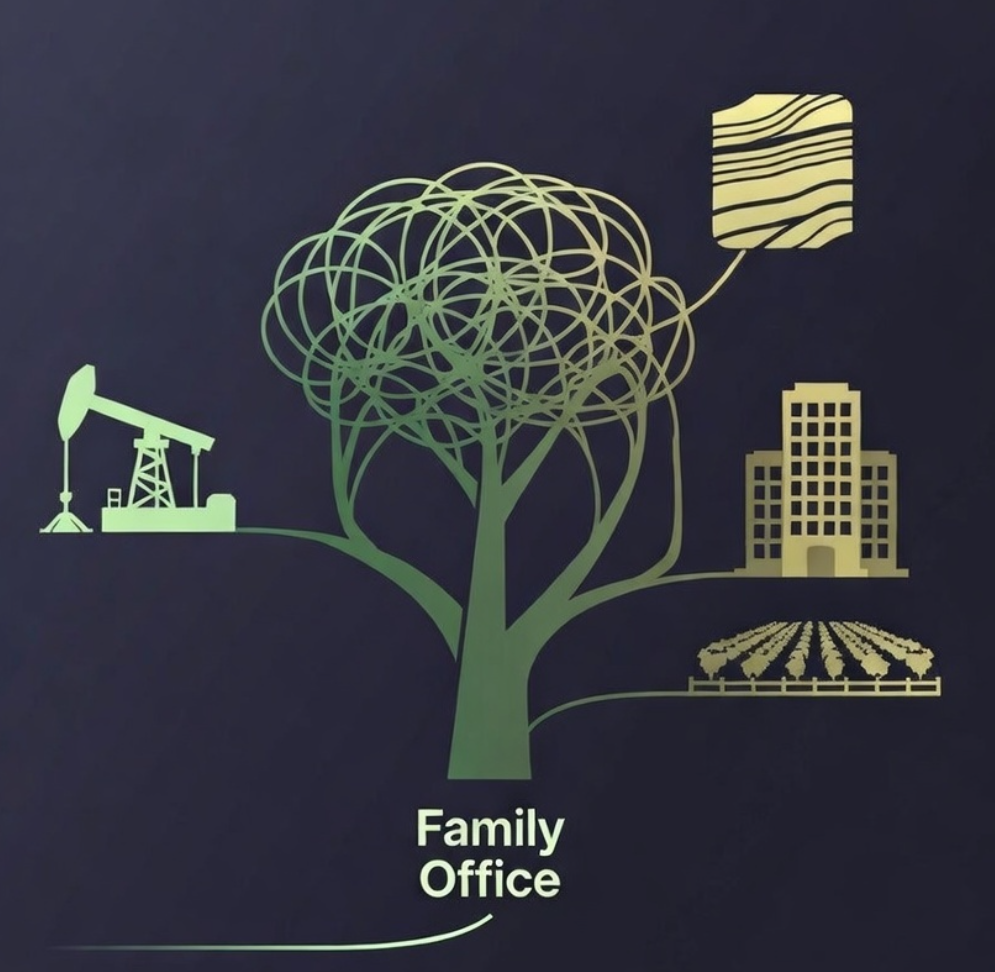
Upstream O&G has always attracted patient capital. The economics reward it — long-lived assets, reserve-backed cash flows, decades of operational muscle memory. And as the family office and private fund space has grown — particularly among newer energy-focused funds standing up their first institutional infrastructure — what we're encountering are family offices and funds holding a mix of hard assets — O&G, minerals, real estate, sometimes agricultural land, in one case a winery — with no clean way to see all of it in one place.
The asset mix varies. What we keep hearing about, across nearly every one of these conversations, is a version of the same data challenge underneath it.
Many Assets. Many Systems. Hard to See the Whole Picture.
Each asset class tends to come with its own system of record. O&G operations have their production and accounting platforms. Mineral interests have their royalty management tools. Real estate has its property management and bookkeeping software. And whatever else is in the portfolio tends to have something else entirely.
Those tools generally do what they were built for reasonably well. What they weren't built for — and what we hear about consistently — is talking to each other.
In most of the conversations we're having, that single unified view of portfolio performance across asset classes isn't coming from a platform. It's coming from a spreadsheet — stitched together manually, updated at month-end, and maintained by someone whose institutional knowledge walks out the door with them when they leave. That may not be universal, but it's consistent enough that we've stopped being surprised by it.
What we're also hearing is that the CFOs and controllers carrying this burden aren't necessarily asking for a new system. More often, they're asking for the systems they already trust to stop creating work for the humans in between them. That distinction feels important — and it's shaping how we think about where orchestration might fit.
What We're Exploring
We've spent the last several years building orchestration infrastructure for investors and lean upstream O&G firms — sitting above existing systems of record to surface unified reporting without asking operators to change how they work.
The multi-asset, family office problem feels like a natural extension of that work. The integration patterns are familiar. What's different is the breadth — and the reporting complexity that comes with asset classes that weren't designed with each other in mind.
Get in touch: We've had some genuinely useful early conversations and want to keep broadening that circle before we build — not to sell anything, but to understand the problem first.